Miami Dolphins vs Las Vegas Raiders Match Player Stats: The Complete Breakdown
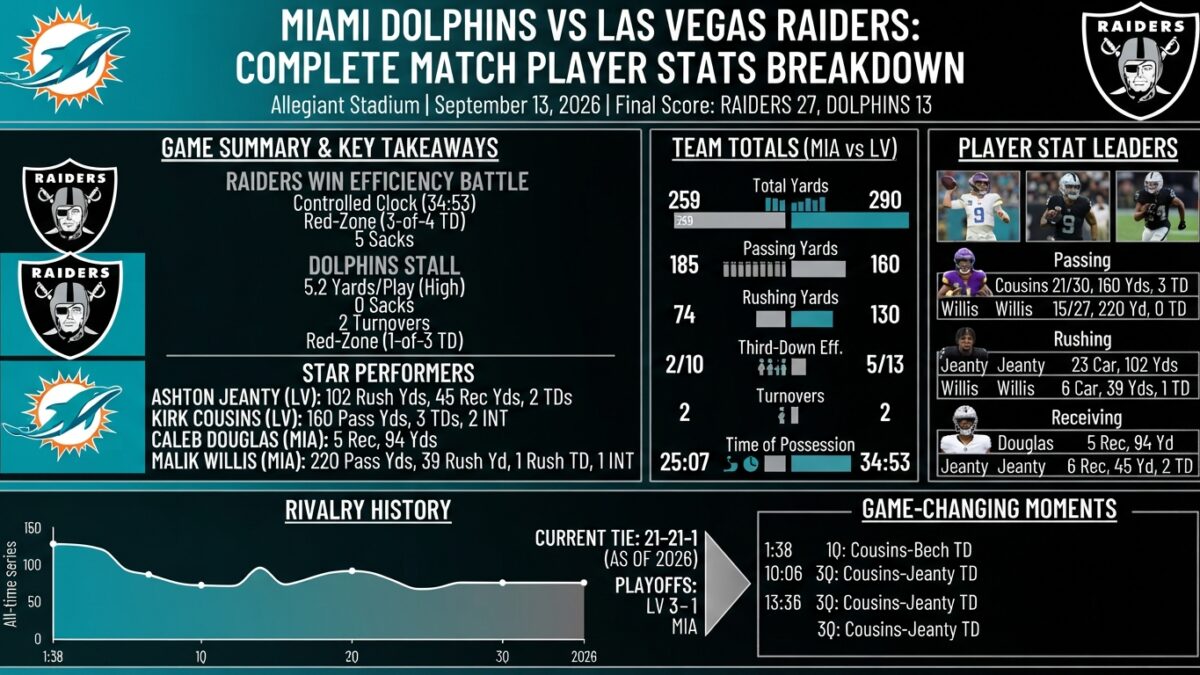
The Miami Dolphins vs Las Vegas Raiders match player stats tell a story of two teams moving in opposite directions. The Raiders controlled the clock, protected the ball, and leaned on a young running back who looks like a cornerstone. The Dolphins flashed speed on the outside but could not finish drives or stop the bleeding when it mattered.
This breakdown covers every statistical angle from their September 13, 2026 meeting at Allegiant Stadium. You get full tables, clear takeaways, and the historical context behind the numbers. No fluff. No filler. Just the Miami Dolphins vs Las Vegas Raiders match player stats you actually need.
A Quick Look at the Rivalry
These two franchises have traded blows for nearly six decades. The all-time series sits at 21–21–1, a dead heat that reflects how often these games come down to the wire. The Raiders dominated the early years, winning 16 of the first 21 meetings. Miami clawed back with a 7–1 stretch from 2012 through 2024, including four straight wins before the 2026 opener.
The postseason history adds extra weight. The Raiders hold a 3–1 edge in playoff meetings, with the most painful loss coming in the 1974 “Sea of Hands” game. That history gives every regular-season matchup a little more bite, even when both teams are rebuilding.
The Miami Dolphins vs Las Vegas Raiders match player stats from 2026 add a new chapter to that long story. The Raiders evened the all-time series and snapped Miami’s recent dominance in the head-to-head.
The Most Recent Matchup: Raiders 27, Dolphins 13
Date: September 13, 2026
Venue: Allegiant Stadium, Las Vegas
Final Score: Raiders 27, Dolphins 13
Attendance: 62,541
This was a statement game for Las Vegas. Kirk Cousins, signed to bridge the gap to rookie Fernando Mendoza, played efficient football. Ashton Jeanty, the sixth overall pick in 2025, looked fully healthy after an ankle scare in training camp. He torched Miami on the ground and through the air.
Miami, under new head coach Jeff Hafley, showed flashes. Malik Willis created plays with his legs. Caleb Douglas stretched the field. But the Dolphins could not sustain drives and gave the ball away twice. The final score flatters Miami slightly; Las Vegas led 27–13 entering the fourth quarter and never let the Dolphins cross the goal line again.
The Miami Dolphins vs Las Vegas Raiders match player stats from this game paint a clear picture: Las Vegas won the efficiency battle, the turnover battle, and the time-of-possession battle.
Team Totals and Efficiency Comparison
The raw numbers show a Las Vegas team that maximized its possessions and a Miami team that moved the ball but stalled.
| Stat | Dolphins (MIA) | Raiders (LV) |
|---|---|---|
| Total Yards | 259 | 290 |
| Passing Yards | 185 | 160 |
| Rushing Yards | 74 | 130 |
| Yards Per Play | 5.2 | 4.3 |
| First Downs | 13 | 21 |
| Third-Down Efficiency | 2-of-10 | 5-of-13 |
| Red-Zone Efficiency | 1-of-3 | 3-of-4 |
| Turnovers | 2 | 2 |
| Time of Possession | 25:07 | 34:53 |
The takeaway: Miami actually averaged more yards per play (5.2 to 4.3), but Las Vegas ran 17 more plays and controlled the clock for nearly 35 minutes. The Raiders converted red-zone trips into touchdowns. The Dolphins settled for field goals. That difference is the game.
The Miami Dolphins vs Las Vegas Raiders match player stats confirm what the scoreboard says: efficiency beats explosiveness when the explosiveness comes with turnovers and stalled drives.
Complete Quarterback Matchup and Passing Stats
Kirk Cousins did not need to be spectacular. He needed to be accurate, and he was. Malik Willis showed why Miami is intrigued by his athleticism, but he also showed why he remains a work in progress as a passer.
| Quarterback | Team | Comp/Att | Yards | TD | INT | Sack | Rating |
|---|---|---|---|---|---|---|---|
| Kirk Cousins | LV | 21/30 | 160 | 3 | 2 | 0 | 88.2 |
| Malik Willis | MIA | 15/27 | 220 | 0 | 1 | 5 | 66.9 |
Cousins threw three touchdown passes against two interceptions. His yardage total was modest (160), but he spread the ball to seven different receivers and never took a sack. He managed the game exactly how Klint Kubiak wanted.
Willis threw for 220 yards, but most of that came in catch-up mode. He was sacked five times, lost 35 yards on those plays, and threw a fourth-quarter interception that ended Miami’s last realistic chance. His rushing touchdown in the third quarter was a bright spot, but the passing numbers tell the fuller story.
The Miami Dolphins vs Las Vegas Raiders match player stats at quarterback highlight a simple truth: Cousins protected the ball better in the red zone, and that decided the game.
Rushing Leaders and Ground Game Performance
Ashton Jeanty was the best player on the field. He finished with 147 total yards and two touchdowns, doing damage as both a runner and a receiver.
| Player | Team | Carries | Yards | Avg | TD | Long |
|---|---|---|---|---|---|---|
| Ashton Jeanty | LV | 23 | 102 | 4.4 | 0 | 19 |
| Malik Willis | MIA | 6 | 39 | 6.5 | 1 | 14 |
| De’Von Achane | MIA | 11 | 36 | 3.3 | 0 | 10 |
| Jaylen Wright | MIA | 1 | -1 | -1.0 | 0 | -1 |
Jeanty carried the ball 23 times for 102 yards, grinding out tough gains between the tackles. He did not score on the ground, but his ability to move the chains kept Cousins in manageable down-and-distance situations all afternoon.
Miami’s ground game never got going. Achane averaged just 3.3 yards per carry. Willis was the Dolphins’ most effective runner, but a quarterback leading the team in rushing yards is rarely a recipe for winning football.
The Miami Dolphins vs Las Vegas Raiders match player stats on the ground show a clear gap in physicality. Las Vegas imposed its will. Miami could not respond.
Receiving Production and Target Breakdown
Caleb Douglas was Miami’s most productive receiver, but the Raiders spread the ball around more effectively.
| Receiver | Team | Rec | Targets | Yards | Avg | TD | Long |
|---|---|---|---|---|---|---|---|
| Caleb Douglas | MIA | 5 | 7 | 94 | 18.8 | 0 | 30 |
| Malik Washington | MIA | 3 | 8 | 53 | 17.7 | 0 | 30 |
| De’Von Achane | MIA | 4 | 5 | 30 | 7.5 | 0 | 14 |
| Ashton Jeanty | LV | 6 | — | 45 | 7.5 | 2 | 13 |
| Jakobi Meyers | LV | — | — | — | — | 1 | — |
Douglas averaged nearly 19 yards per catch and showed the kind of field-stretching ability that Miami’s offense desperately needs. But the Dolphins’ receivers combined for zero touchdowns. Washington saw eight targets but caught only three.
Jeanty was the story on the other side. His two receiving touchdowns came on short passes where he did the work after the catch. Cousins found him in the red zone twice, and Jeanty converted both opportunities.
The Miami Dolphins vs Las Vegas Raiders match player stats in the passing game reveal a familiar problem for Miami: yards between the twenties do not win games. Touchdowns do.
Defensive Plays, Turnovers, and Sacks
Las Vegas won the line of scrimmage on defense. Five sacks, seven tackles for loss, and two interceptions tell the story.
| Defensive Stat | Dolphins (MIA) | Raiders (LV) |
|---|---|---|
| Sacks | 0 | 5 |
| Tackles for Loss | 7 | 7 |
| Interceptions | 2 | 2 |
| Pass Deflections | 5 | 6 |
| Fumbles Lost | 1 | 0 |
Miami’s defense actually intercepted Cousins twice and kept the game from becoming a blowout. J. Rodriguez led the Dolphins with 14 total tackles and five solo stops. But the pass rush never got home. Zero sacks against a 38-year-old quarterback is a problem.
The Raiders, by contrast, harassed Willis all afternoon. Five sacks, 35 yards lost, and constant pressure forced Willis into quick decisions and inaccurate throws. The Miami Dolphins vs Las Vegas Raiders match player stats on defense show that Las Vegas won the disruption battle decisively.
Step-by-Step Game-Changing Moments
First quarter (1:38): Cousins finds J. Bech for a 15-yard touchdown. Raiders 7–0. The tone is set early.
Second quarter (4:12): Riley Patterson hits a 41-yard field goal. Raiders 10–0. Miami finally gets on the board.
Second quarter (1:12): Cousins hits Jeanty for a 13-yard touchdown. Raiders 17–3. The Raiders answer Miami’s field goal with a touchdown.
Third quarter (12:52): Willis scrambles 14 yards for a touchdown. Raiders 17–13. Miami’s best moment of the game.
Third quarter (10:06): Cousins finds Jeanty again for a 13-yard score. Raiders 24–13. The Raiders immediately answer Willis’s touchdown and reclaim control.
Third quarter (2:38): Matt Gay hits a 30-yard field goal. Raiders 27–13. The final points of the game.
The Miami Dolphins vs Las Vegas Raiders match player stats reflect these turning points. Every time Miami gained momentum, Las Vegas took it back.
What the Numbers Tell Us About Each Team
Las Vegas: The Raiders are building something sustainable. Cousins is a bridge, but Jeanty looks like a star. The defense generated pressure without blitzing heavily, and the red-zone offense converted three of four opportunities. If the Raiders can develop Mendoza behind Cousins while Jeanty anchors the run game, this offense has a clear identity.
Miami: The Dolphins have speed but no rhythm. Willis is dynamic as a runner but inconsistent as a passer. The offensive line allowed five sacks and created little room in the run game. The defense kept Miami in the game but could not generate a game-changing play when it needed one. The Miami Dolphins vs Las Vegas Raiders match player stats expose a team still searching for its identity under a new coaching staff.
Looking Back: How the Rivalry Has Unfolded Over Time
The Dolphins and Raiders have produced memorable moments for over 50 years. The 1974 playoff game, the “Sea of Hands,” remains one of the most famous finishes in NFL history. Miami won four straight in the series from 2018 through 2024, including a 34–19 win in 2024. The Raiders’ 2026 victory snapped that streak and evened the all-time series.
The Miami Dolphins vs Las Vegas Raiders match player stats from 2026 fit into a broader pattern: these games are often close, often decided by turnovers, and often carry weight beyond the standings.
Why Player Stats Matter in This Matchup
Box scores tell you who won. They do not always tell you why. The Miami Dolphins vs Las Vegas Raiders match player stats reveal the underlying mechanisms: red-zone efficiency, sack differential, time of possession. Those are the levers that decide football games.
For fantasy football players, this data matters too. Jeanty’s usage as a receiver (six catches, two touchdowns) is a signal. Douglas’s target share (seven targets, five catches) is a signal. Willis’s rushing floor (39 yards, one touchdown) is a signal. The numbers are not just history. They are a map of future opportunity.
Final Thoughts and Fan Community Takeaways
The Raiders won this game because they were more efficient, more physical, and more disciplined in the moments that mattered. The Dolphins lost because they could not protect their quarterback, finish drives, or stop the run when it counted.
If you are a Raiders fan, Jeanty is the reason for optimism. He looked like a player who can carry an offense. Cousins looked like exactly what the Raiders need him to be: a steady hand who does not lose games.
If you are a Dolphins fan, the rebuild is real. Willis is exciting, but he needs time and protection. Douglas is a keeper. The defense has pieces. But the Miami Dolphins vs Las Vegas Raiders match player stats show how far Miami still has to go.
FAQs
Who won the most recent Dolphins vs Raiders game?
The Las Vegas Raiders won 27–13 on September 13, 2026, at Allegiant Stadium.
Who had the best statistical performance in the game?
Ashton Jeanty led all players with 147 total yards and two touchdowns. Kirk Cousins threw three touchdown passes.
How many sacks did the Raiders record?
The Raiders recorded five sacks, while the Dolphins recorded zero.
What is the all-time series record between these teams?
The all-time series is tied 21–21–1.
You Also Like To Read: Las Vegas Raiders vs Denver Broncos Stats: Complete Matchup Guide
Mariam Nazir
Football writer and editor behind Real Madrid CF Independent Guide. Content is researched against official club, LaLiga and UEFA records. About the author · Send a correction