Introduction
The Denver Nuggets and Utah Jazz have produced some wildly different box scores this season. One night it’s a blowout, the next it’s a nail-biter. If you’ve ever pulled up a box score and wondered which numbers actually matter, you’re in the right place.
This guide breaks down the Denver Nuggets vs Utah Jazz match player stats in plain English. You’ll see who delivers, which stats travel well, and how to read the numbers without getting lost in jargon. Whether you’re a fantasy player, a casual fan, or just stat-curious, this breakdown gives you the full picture.
Quick Overview
- Jamal Murray has been the top scorer for Denver in this matchup, averaging 35.0 points across four games.
- Nikola Jokić averages 21.0 points, 14.3 rebounds, and 10.5 assists against Utah this season.
- Utah’s Keyonte George exploded for 36 points in the most recent meeting, a 128–125 Nuggets win.
- The Jazz have been hit hard by injuries, with Lauri Markkanen, Walker Kessler, and others missing time.
- Denver won the season series convincingly, but the margins varied from a 23-point blowout to a 3-point escape.
What Do the Head-to-Head Numbers Say About This Matchup?
The first thing to understand is that “player stats” in this context means per-game averages and totals compiled specifically when these two teams face each other. It’s not the same as overall season stats. A player might average 15 points overall but bump that to 20 against a specific opponent due to matchup advantages or playing style.
According to ESPN’s team stat splits for Nuggets vs. Jazz, Denver has controlled the glass and the assist column in most meetings. The Nuggets’ ball movement tends to carve up Utah’s defense, which allows the most points in the Western Conference.
Here’s the simplest takeaway: Denver’s stars have feasted, but Utah’s young guards have also had moments. The stats aren’t one-sided in every category.
How Do Jamal Murray and Nikola Jokić Perform Against Utah?
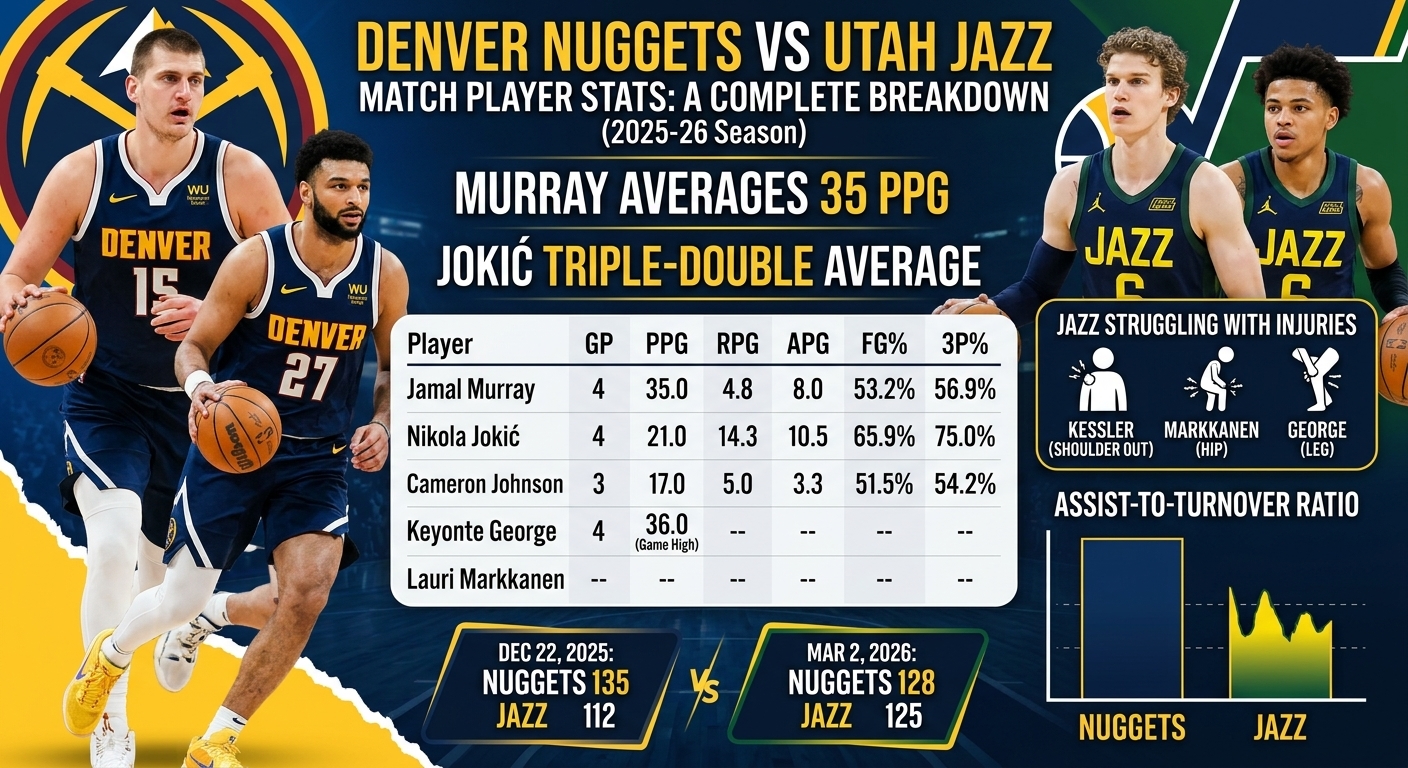
Jamal Murray has been the standout scorer in this series. In four games against the Jazz, he’s put up 35.0 points per game on absurd efficiency: 53.2% from the field and 56.9% from three-point range. That’s not a typo—he’s made over seven threes per game in these matchups.
Nikola Jokić, meanwhile, has been a triple-double machine. His averages of 21.0 points, 14.3 rebounds, and 10.5 assists illustrate how he controls the game without needing to score 30. He’s shot 65.9% from the field in these four games, and his plus-minus of +47 reflects his overall impact.
Key Player Stats: Nuggets vs. Jazz (2025–26)
| Player | GP | PPG | RPG | APG | FG% | 3P% |
|---|---|---|---|---|---|---|
| Jamal Murray | 4 | 35.0 | 4.8 | 8.0 | 53.2% | 56.9% |
| Nikola Jokić | 4 | 21.0 | 14.3 | 10.5 | 65.9% | 75.0% |
| Cameron Johnson | 3 | 17.0 | 5.0 | 3.3 | 51.5% | 54.2% |
| Tim Hardaway Jr. | 4 | 13.0 | 2.5 | 0.8 | 40.5% | 38.2% |
| Jonas Valančiūnas | 3 | 12.7 | 7.7 | 0.7 | 52.2% | 0.0% |
Data compiled from StatMuse and ESPN box scores.
That table tells a clear story: Denver’s top two players have been nearly unstoppable. Murray’s scoring volume and Jokić’s all-around production create a two-headed problem Utah hasn’t solved.
Which Jazz Players Step Up Against Denver?
Utah’s individual numbers have been more volatile, largely because of injuries. Keyonte George has had the brightest moments. In the March 2, 2026 meeting, he dropped 36 points on 14-of-22 shooting, nearly willing the Jazz to an upset.
Lauri Markkanen scored 27 points in the December 22 game, but he’s been in and out of the lineup with hip issues. Jusuf Nurkić contributed 17 points and 14 rebounds in that same December game, showing he can punish Denver on the boards when healthy.
The problem for Utah is consistency. When Markkanen, Kessler, and Collin Sexton are unavailable, the scoring load falls on younger players who haven’t yet proven they can sustain that level against a defense like Denver’s.
How Do the Teams Compare Statistically?
Zoom out from individual lines, and the team-level numbers explain why Denver has won most of these meetings. The Nuggets average 127.0 points over their last 10 games overall, while the Jazz have allowed 127.6 points per game in their last 10. That’s a recipe for high-scoring Denver nights.
Utah does force turnovers and can score in transition, but half-court execution has been a struggle. Denver’s assist-to-turnover ratio in these matchups has been noticeably better, which reflects Jokić’s decision-making and Murray’s shot creation.
For a deeper dive into the season-series trends, NBA.com’s season series wrap-up notes that Denver averages 28.8 assists per game as a team, fifth-best in the league, while Utah gives up the most points in the West.
Definition: Assist-to-turnover ratio measures how many assists a player or team records for every turnover. A higher number means better ball security and shot creation.
What Do These Stats Mean for Fantasy Basketball and Betting?
If you play fantasy basketball, the Nuggets-Jazz matchups have been gold. Murray’s 35-point average is elite, and Jokić’s triple-double upside makes him a must-start in any format. The supporting cast—Cameron Johnson, Tim Hardaway Jr., and Jonas Valančiūnas—have also posted useful streaming numbers depending on the night.
For bettors, the totals have been interesting. The December 22 game featured a 135–112 score, easily clearing most over/unders. But the March 2 game landed at 253 total points, a closer number. The lesson: Denver’s offense is reliable, but Utah’s pace and injury situation can swing the total either way.
One useful stat to track is true shooting percentage (TS%), which accounts for free throws and three-pointers. Murray’s TS% against Utah this season is 76.3%—a number that would lead the league by a wide margin if sustained.
How Have Injuries Shaped the Nuggets-Jazz Matchups?
Injuries have been the hidden variable in this series. Utah has been without Walker Kessler (shoulder, out for season), Lauri Markkanen (hip), and Keyonte George (leg) for stretches. That has forced coach Will Hardy to rely on lineups that simply don’t have the firepower to keep up with Denver.
Denver has had its own absences—Aaron Gordon missed time, and Peyton Watson sat out two games before returning—but the core of Murray and Jokić has remained intact. When both are on the floor, Denver’s net rating in these matchups is dramatically better than when either sits.
The takeaway for readers is simple: always check the injury report before drawing conclusions from player stats. A 20-point average looks different if half those games came against a depleted roster.
What Can We Learn From the Most Recent Games?
Two games tell the story of this season series better than any average.
December 22, 2025: Nuggets 135, Jazz 112. Denver opened the game on a 19–0 run and never looked back. Murray scored 27, Jokić posted a triple-double (14 points, 13 rebounds, 13 assists), and the Nuggets tied a franchise record with 24 three-pointers. Utah shot poorly early and couldn’t recover.
March 2, 2026: Nuggets 128, Jazz 125. This one was a thriller. Murray exploded for 45 points, but Keyonte George answered with 36 for Utah. Jokić added 22 points and 12 rebounds, and the game came down to the final possession. It proved that even a shorthanded Jazz team can push Denver to the limit when George is hot.
Those two games illustrate the range of outcomes: Denver can blow the doors off, but Utah’s young guards can make it uncomfortable.
Key Takeaways
- Jamal Murray is the headline act in this matchup, averaging 35 points on elite efficiency.
- Nikola Jokić’s triple-double average makes him the engine behind Denver’s success.
- Utah’s best moments come from Keyonte George and Lauri Markkanen, but injuries have limited their consistency.
- Team-level stats favor Denver in assists, shooting efficiency, and rebounding.
- Always factor in injuries before relying on historical player stats for fantasy or betting decisions.
FAQ
What is Jamal Murray’s average against the Utah Jazz this season?
Murray averaged 35.0 points, 4.8 rebounds, and 8.0 assists across four games, shooting 53.2% from the field and 56.9% from three-point range.
How many triple-doubles does Nikola Jokić have against Utah in 2025–26?
Jokić recorded multiple triple-doubles in the series, including a 14-point, 13-rebound, 13-assist performance on December 22, 2025. His per-game averages in the matchup were 21.0 points, 14.3 rebounds, and 10.5 assists.
Who scored the most points in a single game in this matchup this season?
Jamal Murray scored 45 points on March 2, 2026. Keyonte George scored 36 for Utah in the same game, the highest single-game total by a Jazz player in the series.
Are the Utah Jazz healthy for these matchups?
No. Utah has dealt with significant injuries, including season-ending issues for Walker Kessler and missed games for Lauri Markkanen and Keyonte George. Those absences have directly affected the player stats in this series.
What does true shooting percentage tell us about these performances?
True shooting percentage accounts for field goals, three-pointers, and free throws. Murray’s 76.3 TS% against Utah is exceptionally high, showing his scoring has been both voluminous and efficient.
Do the Nuggets or Jazz have the better assist-to-turnover ratio in this matchup?
Denver has consistently posted a better assist-to-turnover ratio, driven by Jokić’s playmaking and Murray’s ball handling. Utah’s younger backcourt has been more turnover-prone against Denver’s defense.
Conclusion
The numbers paint a clear picture: Denver’s stars have dominated this matchup, while Utah’s best players have flashed potential without sustained support. If you’re reading box scores, start with Murray and Jokić—they’re the constants. Then check the injury report, because Utah’s lineup changes everything.
Stats tell stories, but context makes them useful. Now you have both.
You Also Like To Read: Milwaukee Brewers vs Chicago Cubs Match Player Stats: Complete Game Breakdown