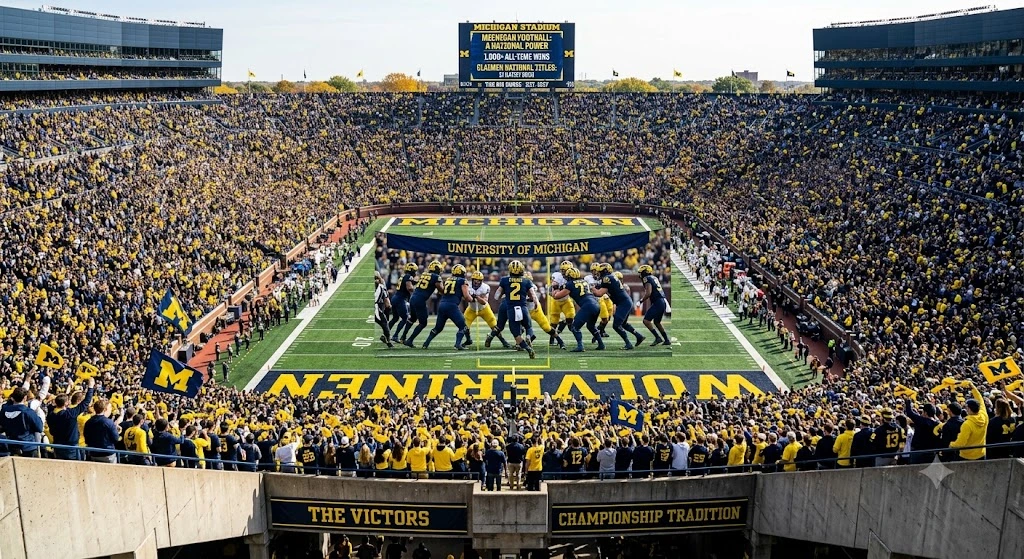
Struggling to grasp the massive history of the Wolverines? Missing out on the legendary moments and iconic figures leaves you disconnected from true college sports culture. This guide breaks down the complete legacy of Michigan Football, giving you the ultimate resource on the program’s championship dominance and unforgettable traditions.
Michigan Football Biography & Quick Facts
| Entity | Details |
|---|---|
| Official Name | University of Michigan Wolverines |
| First Season | 1879 |
| Location | Ann Arbor, Michigan |
| Stadium | Michigan Stadium (The Big House) |
| Stadium Capacity | 107,601 (Largest in the United States) |
| Conference | Big Ten Conference |
| Claimed National Titles | 12 (Latest: 2023) |
| Conference Titles | 44 Big Ten Championships |
| Heisman Trophy Winners | 3 (Tom Harmon, Desmond Howard, Charles Woodson) |
| All-Time Record | 1,000+ Wins (First program to reach milestone) |
| Head Coach | Sherrone Moore (Current) |
| Legendary Coaches | Fielding H. Yost, Bo Schembechler, Lloyd Carr, Jim Harbaugh |
| Fight Song | “The Victors” |
| Primary Rival | Ohio State Buckeyes |
What Is the History of Michigan Football?
The story of Michigan Football starts in 1879, making it one of the oldest college football programs in America. The Wolverines played their first game against Racine College, securing a 1-0 victory. This early success sparked a culture of winning that persists today.
During the early 1900s, coach Fielding H. Yost built the famous “Point-a-Minute” teams. These squads outscored opponents by such massive margins that opponents often quit by halftime. According to the NCAA official records, Michigan secured its first national championship in 1901. This dominant era established the Wolverines as a national powerhouse early in the sport’s history. The program continued to grow, joining the Western Conference (now the Big Ten) and setting attendance records that still stand.
Who Are the Greatest Coaches in Michigan Football History?
The Wolverines boast a coaching tree filled with Hall of Fame talent. Fielding H. Yost laid the foundation with six national titles and 165 victories. His innovative strategies changed how the game was played.
Following Yost, Fritz Crisler introduced the iconic winged helmet and won a national championship in 1947. However, no coach defines the program’s tough identity quite like Bo Schembechler. Taking over in 1969, Schembechler preached physical defense and a punishing ground game. His famous quote, “Those who stay will be champions,” remains a team motto. Later, Lloyd Carr captured the 1997 national championship, and Jim Harbaugh recently led the program back to the mountain top with a perfect 2023 season. Each coach added a distinct chapter to the Michigan Football story.
How Many National Championships Does Michigan Football Hold?
Michigan Football claims 12 national championships across its history. The early titles came under Yost in 1901, 1902, 1903, 1904, 1918, and 1923. The program added more titles in 1932, 1933, and 1947 under coaches Harry Kipke and Fritz Crisler.
After a long drought, Lloyd Carr led the 1997 team to a perfect 12-0 record. Led by cornerback Charles Woodson, the Wolverines defeated Washington State in the Rose Bowl to secure the Associated Press (AP) National Championship. Most recently, Jim Harbaugh guided the 2023 squad to a 15-0 record. They beat Washington in the College Football Playoff National Championship, bringing the trophy back to Ann Arbor.
Why Is the Big House So Important to Michigan Football?
Michigan Stadium, famously known as the “Big House,” serves as the fortress for the Wolverines. Built in 1927, the stadium originally held 72,000 fans. Over decades, the university expanded the venue to hold over 107,000 spectators. It stands as the largest stadium in the United States and the third-largest globally.
On game days, the crowd noise creates a massive home-field advantage. The sheer volume of fans makes communication nearly impossible for opposing offenses. Visiting teams must practice with silent snap counts all week. When the Wolverines take the field, the roar of 100,000+ fans shakes the ground. The Big House is not just a venue; it is the physical heartbeat of Michigan Football.
What Are the Biggest Rivalries in Michigan Football?
The Wolverines participate in three major rivalries that define their season. The most famous battle is against the Ohio State Buckeyes, simply called “The Game.” This rivalry determines the Big Ten East champion almost every year. According to the Big Ten Conference archives, this matchup dates back to 1897 and features intense animosity and elite talent.
The Battle for the Paul Bunyan Trophy against Michigan State holds immense in-state importance. Bragging rights for the entire state rest on this game. Finally, the contest against Notre Dame pits two of college football’s most historic programs against each other. Winning these rivalry games dictates whether a season is considered a success in Ann Arbor.
How Did Jim Harbaugh Transform Michigan Football?
When Jim Harbaugh returned to coach his alma mater in 2015, the program struggled to beat its biggest rivals. Harbaugh immediately instilled a physical, run-first mentality. He recruited dominant offensive lines and athletic quarterbacks who could extend plays.
His transformation reached its peak during the 2021 and 2022 seasons, where the Wolverines won back-to-back Big Ten titles and defeated Ohio State consecutively. Harbaugh’s methods culminated in the 2023 season. Despite early season distractions and his own suspensions, he kept the team focused. They conquered the College Football Playoff, proving his system works at the highest level. Harbaugh restored the standard of excellence for Michigan Football before departing for the NFL.
What Does Sherrone Moore Bring to Michigan Football Now?
Following the 2023 championship, Jim Harbaugh left for the Los Angeles Chargers. The university promoted offensive coordinator Sherrone Moore to head coach. Moore served as the interim head coach during Harbaugh’s suspensions in 2023, going 4-0, including a massive win over Penn State and a victory over Ohio State.
Moore brings continuity and a player-first culture. He possesses deep connections with the current roster and maintains the physical, run-heavy offensive identity. Moore focuses on developing talent and keeping the Wolverines at the top of the Big Ten. His promotion ensures the program avoids a rebuild and stays on the championship track.
Which Michigan Football Players Won the Heisman Trophy?
Three Wolverines have won the Heisman Trophy, awarded to the most outstanding player in college football. Tom Harmon won the award in 1940. He dominated opponents, scoring 33 touchdowns in his final season while playing running back, quarterback, and kicker.
Desmond Howard captured the trophy in 1991 as an electrifying wide receiver and return specialist. His famous Heisman pose in the end zone against Ohio State remains an iconic sports moment. Charles Woodson won the award in 1997, becoming the first primarily defensive player to win the Heisman. Woodson intercepted passes, caught crucial offensive passes, and returned punts for touchdowns. These three players represent the pinnacle of individual excellence in Michigan Football.
What Makes the Michigan Football Winged Helmet Iconic?
The winged helmet stands as the most recognizable symbol in college sports. Coach Fritz Crisler introduced the design in 1938 when he arrived from Princeton. He wanted a way to help his receivers spot their quarterbacks downfield. The distinctive maize and blue stripes allowed players to quickly identify their teammates.
The design quickly transcended its practical purpose. It became a symbol of speed, aggression, and winning. Nike and other apparel brands frequently feature the helmet on team merchandise. When players put on the winged helmet, they carry the weight of a century of tradition. It signals to opponents that a fierce battle is about to begin.
How Does Michigan Football Recruit Top Talent?
Recruiting at Michigan focuses on evaluating talent and character. The coaching staff targets players who fit their physical, pro-style offensive system and aggressive defensive schemes. They prioritize building strong relationships with high school coaches across the Midwest and nationwide.
The program sells recruits on elite player development. Michigan consistently produces first-round NFL Draft picks, especially on the offensive and defensive lines. Prospects see the Wolverines as a direct path to professional football. Furthermore, the academic prestige of the University of Michigan offers a powerful backup plan for life after sports. This combination of athletic success and academic excellence attracts high-character athletes.
What Are the Most Memorable Michigan Football Games?
Several games define the Wolverine legacy. The 1969 upset over top-ranked Ohio State stands out as a monumental turning point. First-year coach Bo Schembechler led his team to a 24-12 victory over his mentor, Woody Hayes, kicking off the “Ten Year War.”
The 1997 Rose Bowl victory over Washington State secured the national championship and cemented Charles Woodson’s legacy. Recently, the 2021 victory over Ohio State ended an eight-game losing streak to the Buckeyes, sparking tears of joy from the senior class. Finally, the 2023 Rose Bowl comeback against Alabama showcased incredible resilience. Jalen Milroe’s failed fourth-down attempt in overtime secured a spot in the national title game.
How Has Michigan Football Dominated the Big Ten?
The Wolverines own the most wins in Big Ten Conference history. They hold 44 conference championships, consistently setting the standard for Midwest football. This dominance relies on a simple philosophy: control the line of scrimmage.
Michigan builds its teams from the inside out. Powerful offensive lines open lanes for running backs, while physical defensive lines stop opposing rushing attacks. This ground-and-pound style travels well in cold, late-season Big Ten weather. Teams that cannot stop the run cannot beat the Wolverines in November. This consistent identity allows Michigan to dominate conference play year after year.
Michigan Football FAQs
1. Why is Michigan Football called the Wolverines? The exact origin remains a mystery, but the nickname dates back to the 1800s. Historians believe it stems from the violent border dispute between Michigan and Ohio known as the Toledo War, where Ohioans compared Michiganders to wolverines due to their fierce, stubborn nature.
2. How many times has Michigan Football beaten Ohio State? Michigan leads the all-time series with over 60 victories. The Wolverines have won the three most recent matchups, asserting current dominance in the rivalry after a rough stretch in the 2010s.
3. What is the capacity of the Big House? Michigan Stadium officially seats 107,601 fans. However, the stadium has hosted crowds exceeding 115,000 during events where extra seating is added. It holds the NCAA record for single-game attendance.
4. Who is the all-time leading rusher in Michigan Football history? Mike Hart holds the school record for career rushing yards with 4,397 yards. He played from 2004 to 2007 and currently serves as a coach on the staff, continuing to develop elite running backs.
5. When did Michigan Football last win a National Championship? The Wolverines won their most recent national championship on January 8, 2024. They defeated the Washington Huskies 34-13 to cap off a perfect 15-0 season.
6. What conference does Michigan Football play in? Michigan competes in the Big Ten Conference. With recent conference realignment, the Big Ten continues to grow, but Michigan remains the historical cornerstone of the league.
The legacy of the Wolverines proves that a commitment to physical football and unyielding standards creates lasting success. From the early days of Fielding Yost to the modern championships under Jim Harbaugh, this program demands excellence. If you want to experience the pinnacle of college sports, make sure you catch a game at the Big House this fall. Share your favorite Michigan Football memory in the comments below!